Does an LED Retrofit Void a Hazardous Location Luminaire’s Listing?
It is the first question every plant engineer asks, and for years the answer was genuinely unclear. The 2026 National Electrical Code has now settled it — but not in the way either side of the argument usually claims.
If you have ever proposed converting a legacy explosionproof luminaire to LED, you have heard the objection. Someone in the room says that modifying a certified fixture voids its listing, that the hazardous location certification belongs to the original manufacturer, and that the only compliant path is full replacement.
That objection deserves a serious answer rather than a sales response. Here is what the code and the certification bodies actually say.
The short answer
Retrofitting a luminaire does not void the original listing — but that fact alone does not make a retrofit compliant.
Both halves matter. The listing question and the compliance question are different questions, and most of the confusion in this market comes from collapsing them into one.
Where the confusion comes from
The original equipment manufacturer applies its certification mark at the factory. That mark is the manufacturer’s attestation that the product met the applicable standard when it shipped. UL Solutions states plainly that retrofitting an installed luminaire does not affect that original listing.
UL is equally direct on a second point that surprises people: permission from the original luminaire manufacturer is not required. Conversion is the facility owner’s decision and responsibility. It may end whatever warranty coverage remains, which is a real commercial consideration — but a warranty position is not a code position, and the two are often presented as though they were the same thing.
So the “you’ll void the listing” framing is not quite right. The better question is: what is the compliance status of the converted luminaire?
What the 2026 NEC actually says
Three provisions govern this, and they work together.
Article 100 defines a retrofit kit as a general term for a complete subassembly of parts and devices for field conversion of utilization equipment. Definitions matter here, because the code’s permissions attach to that defined term and not to field modification generally.
Section 410.6 requires that luminaire retrofit kits be listed. This has been in the code for several cycles and applies everywhere, classified or not. It is the reason an electrician cannot assemble a conversion from off-the-shelf components. UL notes that a luminaire modified with off-the-shelf parts is simply field-modified electrical equipment, and would require a field evaluation to establish compliance.
Section 501.130(C) is the new provision, and it is the one that changes the conversation. It permits luminaires to be modified using retrofit kits that are listed for the location and listed for field installation with the luminaire being retrofitted. Parallel revisions appear in Articles 502 and 503 for Class II and Class III locations.
Read that language closely, because the precision is the whole point. It is a two-part test:
- Listed for the location. The kit must be certified for the specific classified environment — Class, Division or Zone, gas or dust group.
- Listed for field installation with the luminaire being retrofitted. The certification must contemplate that host fixture. A generic hazardous location listing on a product does not satisfy this half of the test.
Before 2026, installers arguing for a retrofit had to reason by analogy from Article 410 and general equipment-suitability requirements. Now there is a provision written for the situation.
The critical distinction: listed kits, not retrofits generally
This is where honest treatment of the topic diverges from marketing.
The 2026 NEC did not legalize retrofitting hazardous location luminaires. It recognized a narrow, specific pathway for listed kits meeting both conditions above. Everything outside that pathway is exactly as noncompliant as it was in 2023.
The standards behind the certification are worth naming, because vendors are inconsistent about this. UL 1598C is the standard for LED retrofit luminaire conversion kits, but on its own it addresses ordinary locations. UL 844 is the standard for luminaires used in hazardous (classified) locations. For hazardous location conversion kits, UL certifies to both, under product category code, the ordinary-location category.
If a supplier cites only UL 1598C for a product going into a Division 1 or Division 2 area, that is a gap, not a technicality.
Two ways to satisfy the second half of the test
Kits can be certified either for specific host luminaire models or for generic host types meeting mechanical and electrical criteria stated in the installation instructions. Where specific models are covered, the manufacturer and model numbers appear both in the instructions and on the package.
Either approach is legitimate. The specific-model approach is easier to verify in the field, which is why cross-reference tables like this one exist:
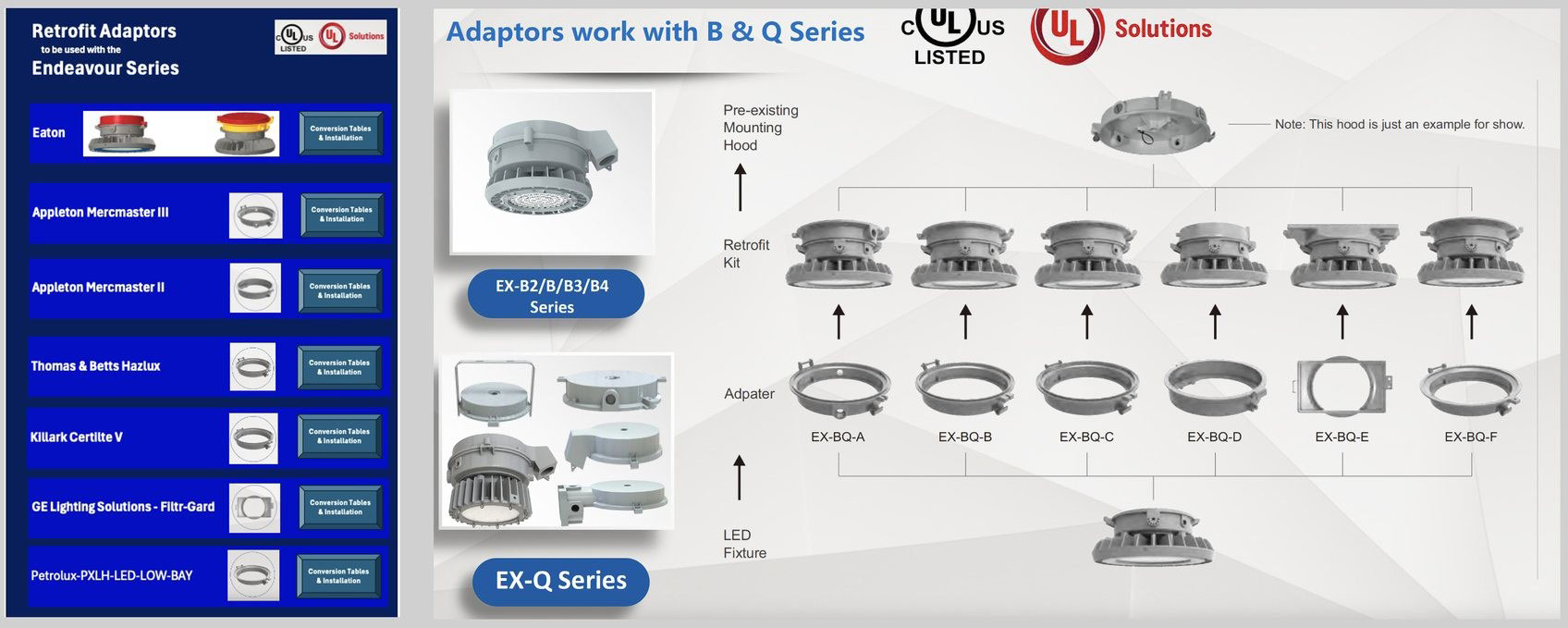
 The architecture shown at right is worth pausing on, because it addresses the underlying safety concern rather than arguing around it. In an explosionproof: it contains an internal ignition and cools escaping gases below the ignition temperature as they pass through a machined flame path. Any approach that disturbs that flame path deserves scrutiny. An approach that retains proven-in-place mounting hardware and brings a fully certified assembly to it is answering the concern, not deflecting it.
What to do in a jurisdiction on an older code
Here is the practical complication. The 2026 NEC exists, but adoption happens state by state and lags publication by years. Most jurisdictions are still enforcing the 2020 or 2023 edition, and some are further behind. NFPA maintains enforcement maps showing state-level adoption, and free read-only access is available through NFPA LiNK.
If 501.130(C) is not yet in force where you are working, the argument runs through the provisions that were already there: 410.6’s listing requirement for retrofit kits, together with the general requirement — reflected in OSHA 1910.307 — that equipment be suitable and identified. A kit certified under IFUL satisfies both. It is a slightly longer conversation with the authority having jurisdiction, but it is not a weaker one — and pointing to the direction the code has since moved tends to help.
One more practical note in the retrofit column: UL indicates that when a certified kit is installed in strict adherence to its installation instructions, a field evaluation should not be required. Field evaluation becomes appropriate when an uncertified kit was used or an unqualified person performed the work. On a live process unit, avoiding that step.
Five questions to ask any supplier
Use these on us as readily as on anyone else. A longer version — with the public-database lookups and the red flags that go with them.
- Which standards? For a classified location the answer should include UL 844, not UL 1598C alone.
- What is the product category code and file number? Look it up yourself in UL Product iQ. IFUL is the hazardous location conversion kit category.
- Which host luminaires? Either named models or explicit generic criteria. “Most standard fixtures” is not an answer.
- What is the resulting marking? temperature code, and ambient range for the converted luminaire — not for a component inside it.
- What label goes on afterward? Certified kits include field-applied labels to affix to the host luminaire after conversion.
If a supplier cannot answer all five in writing, the conversation is over regardless of what the code permits. And if you encounter certification marks being used on products that do not hold the certification.
The bottom line
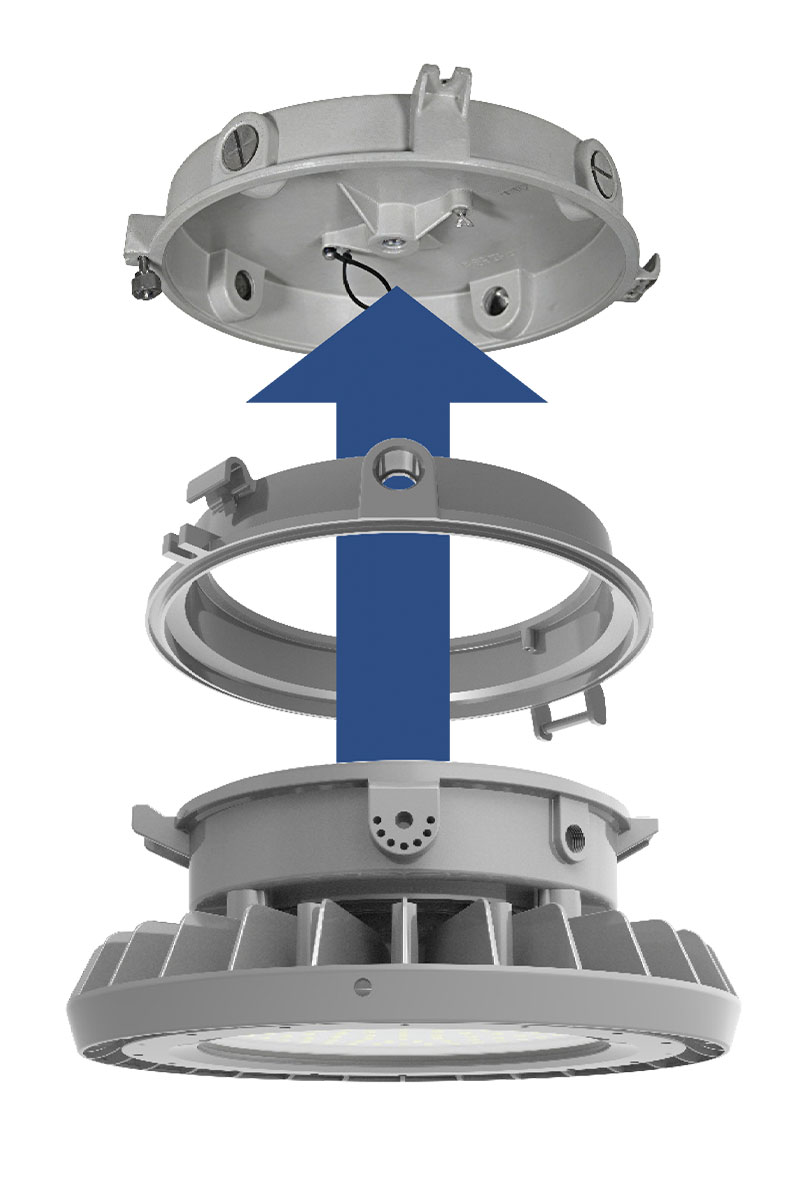 Retrofitting does not void the original manufacturer’s listing, and the original manufacturer’s permission is not required. But neither of those facts makes an arbitrary conversion compliant. What makes it compliant is a certified kit, listed for the location and listed for use with that host luminaire, installed exactly per its instructions and labeled accordingly — and, in a PSM facility, carried through management of change rather than treated as a replacement in kind.
The 2026 NEC did not lower the bar. It described precisely where the bar is. For anyone who was already clearing it, that is very good news.
[Placeholder for product close: state the UL file number, product category code, Class/Division, groups, T-code and ambient range for the converted luminaire, and link to the conversion tables and installation documents for each host family.]
Related in This Series
- How to Vet a Hazardous Location Retrofit Claim: A Buyer’s Due-Diligence Checklist — Ten questions, the public databases that answer them, and seven red flags.
- What Happens to the T-Code When You Change the Light Source — Why a temperature classification belongs to a tested assembly, not to a housing.
- Flamepath Integrity: Why the Enclosure Is the Safety Device — How the machined gap does the work, and what damages it.
- The True Installed Cost of Fixture Replacement Versus Retrofit in a Live Process Unit — Why a $640 fixture is a $3,000+ event, and where retrofit actually saves.
- The Obsolescence Clock on Your Installed Base — Spare-parts risk, state sales bans, and what DOE actually decided in February 2026.
- The Documentation Package: MOC, the AHJ Conversation, and Closing Out the Project — What the inspector wants, and what belongs in the asset register.
- Lighting Quality and Worker Safety in Petroleum Facilities — Illuminance, colour rendering, glare, flicker, and egress as outcomes.
- Why Inexpensive Hazardous Location LEDs Fail in Year Three — Driver heat, sulfide creep, salt fog, vibration, and enclosure breathing.
Standards and references: NFPA 70 / National Electrical Code · NEC free access · NEC enforcement maps · Understanding NFPA 70 · UL 844 luminaires for hazardous locations · UL Standards store · UL retrofit kit FAQ · UL hazardous locations services · UL Product iQ · IFUL category · IFAR category · UL market surveillance reporting · OSHA 1910.307 · IECEx
This article is general information about published codes and standards, not a compliance determination for any specific installation. Code editions, local amendments, and product certifications vary. Confirm requirements with the authority having jurisdiction and verify any certification claim directly in the certifying body’s database.
About The Author
Rick Nathans and Doug Lauck are the CEO and COO of SpecGrade. Both have worked in LED lighting since 2010 and have contributed to the design of numerous LED luminaires. They stay close to the details — temperature codes and area classifications, driver selection, optics, mounting hardware, and serviceability — which lets them support customers through design reviews, standards compliance discussions, and value engineering exercises with safety and uptime front and center.
About SpecGrade
Based in Columbus, Ohio, SpecGrade designs and distributes commercial and industrial LED luminaires for mission-critical environments where safety, uptime, and compliance are non-negotiable. Its position in the supply chain allows for certain fixture modifications while maintaining UL 844 compliance, along with updated BIM/Revit files for the project. Many of SpecGrade’s industrial fixtures are purpose-built for hazardous and classified locations containing flammable gases, vapors, combustible dusts, or ignitable fibers, protecting people, facilities, and assets while delivering dependable, high-quality illumination.