
The Obsolescence Clock on Your Installed Base
There is no federal HID ban. The real risk to your installed base is supply-side: state sales bans, RoHS expiries, and manufacturers exiting SKUs. Here is how to measure your exposure.
There is no federal HID ban. The real risk to your installed base is supply-side: state sales bans, RoHS expiries, and manufacturers exiting SKUs. Here is how to measure your exposure.
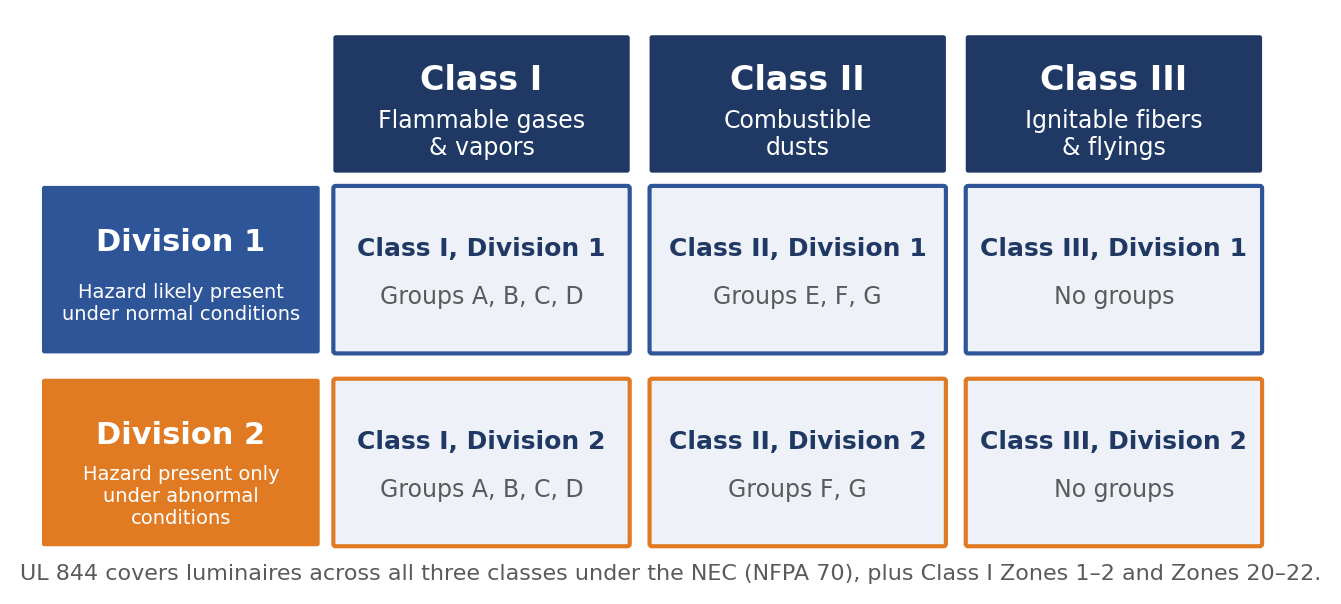
Every marking on a hazardous-area nameplate is a claim about a place. Not about how rugged the equipment is, not about how well it’s sealed, not about its quality.
A ventilation failure in a gallery is a Division 2 event. A power failure in the same gallery can be the cause of that ventilation failure. So the moment emergency...
Luminaire schedules for wastewater plants often list "IP66 / NEMA 4X" as though the two ratings were interchangeable. They are not. They come from...
Walk through the headworks of an older plant and you can often read the atmosphere on the fixtures: green and black corrosion on fittings, flaking paint on...
See how high-temperature hazardous location LED fixtures hold their T-code in refineries and Petrochem plants, and why UL 844 certification matters.
Ask ten people on a plant site what “explosion proof” means and nine will tell you the enclosure keeps the explosive atmosphere out.
A cost estimator opens a lighting upgrade request for a hydrotreater unit. Ninety-six explosion proof fixtures, quoted at $640 each.
It is the first question every plant engineer asks, and for years the answer was genuinely unclear. The 2026 National Electrical Code has now settled it...
A certification mark on a product sheet is a claim. The entry in the certifying body’s public database is the proof.
Every fixture energized, every lamp burning, total connected load exactly per the design basis — and an operator still can’t read the sight glass on a pump seal pot at 2 a.m...
The failure has a signature, and once you’ve seen it a few times you can predict it. It isn’t gradual. Nobody walks a unit and observes that the lighting has softly declined to 70% of its original output.
The engineer is convinced and the PO still isn't signed. Here is what the inspector wants, how a retrofitted luminaire gets marked, and how to close out MOC, the asset register, and rebates.
Lighting in a GMP pharmaceutical manufacturing facility is more than an architectural or energy-efficiency decision. It is part of the controlled environment that supports product quality,...
Lighting submittals in pharmaceutical projects are usually evaluated on four numbers: wattage, delivered lumens, efficacy, and correlated color temperature.