IP66, IP69K, and NEMA 4X: Washdown Ratings for Wastewater Lighting
Audience: consulting and design engineers
Reading time: 6 minutes
Luminaire schedules for wastewater plants often list “IP66 / NEMA 4X” as though the two ratings were interchangeable. They are not.
They come from different standards bodies, test different things, and one of them says something about corrosion that the other does not. In a plant where operators hose down screening rooms and dewatering floors, the difference is practical.
Three ratings, three questions
IP ratings come from IEC 60529, the International Electrotechnical Commission’s ingress protection standard. The first digit rates protection against solids; the second rates protection against water.
- IP66: dust-tight, and protected against powerful water jets.
- IP67: dust-tight, and protected against temporary immersion.
- IP69K: dust-tight, and protected against close-range high-pressure, high-temperature spray. The 69K designation originated in the German DIN 40050-9 standard for road vehicles and is carried forward in ISO 20653. It is widely used in food processing washdown.
NEMA Types come from NEMA standard 250 and are used in North American specifications. NEMA Type 4 covers hose-directed water, and Type 4X adds corrosion resistance. There is no direct IP equivalent for the corrosion element.
| Rating | Source | Dust | Water | Corrosion |
| IP66 | IEC 60529 | Dust-tight | Powerful jets | Not addressed |
| IP67 | IEC 60529 | Dust-tight | Temporary immersion | Not addressed |
| IP69K | DIN 40050-9 / ISO 20653 | Dust-tight | High-pressure, high-temperature spray | Not addressed |
| NEMA 4X | NEMA 250 | Windblown dust | Hose-directed water | Yes |
A higher IP number is not a superset of the lower ones. An enclosure tested for immersion (IP67) has not necessarily been tested against jets (IP66). If you need both, schedule both.
Where each rating fits in a treatment plant
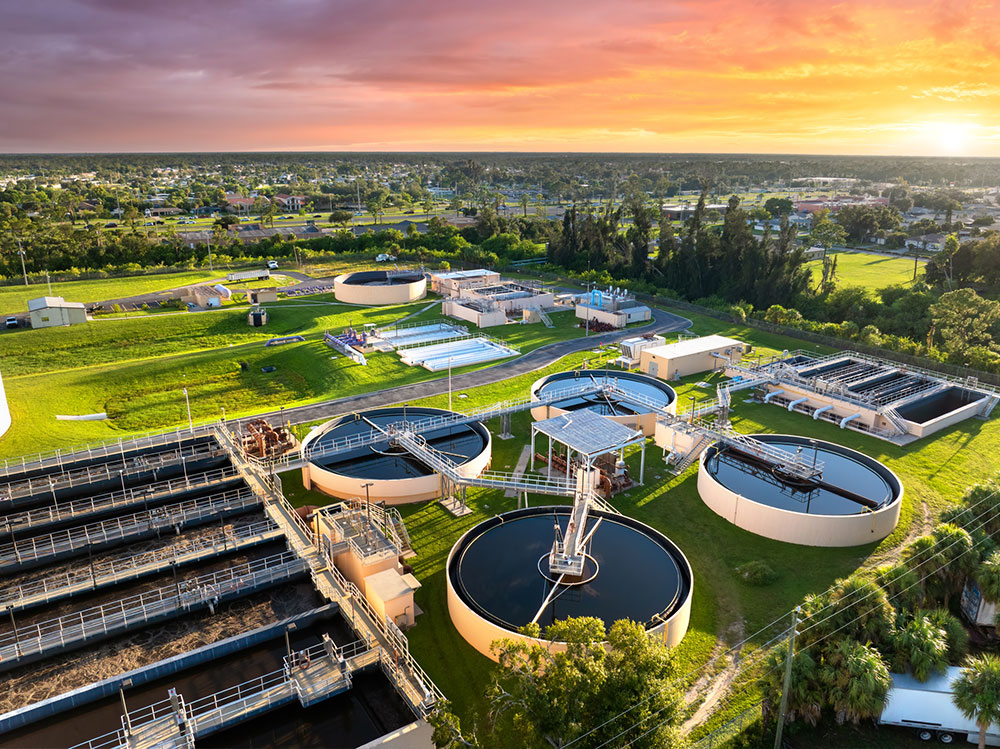
- Headworks, screening, and grit rooms: routine hose-down plus sulfide exposure. Schedule NEMA 4X with IP66 at minimum.
- Dewatering and thickening buildings: frequent washdown, sometimes with pressure washers. Consider IP69K for fixtures within reach of cleaning crews.
- Chemical feed rooms: corrosion matters most; NEMA 4X with chemically compatible materials.
- Galleries and pipe tunnels: condensation and occasional leaks; IP66 and NEMA 4X.
- Outdoor process areas: wet location listing, IP66, UV-stable finishes.
- Wet wells and flood-prone dry pits: evaluate IP67 where submergence is credible.
Ingress ratings do not replace hazardous location listings
An IP or NEMA rating says nothing about ignition protection. In a classified space the luminaire still needs its Class, Division, Group, and temperature code listing. The best practice is to schedule the hazardous location listing, the NEMA Type, and the IP rating as three separate columns and require all three to appear on the submittal data sheet.
Hazardous location luminaires with harsh-environment ratings exist in most major categories. For example, the SpecGrade Discovery hazardous location exit sign is rated NEMA 4X and IP66 with Class I Division 2 qualification, and SpecGrade’s harsh environment resources cover washdown and corrosive-atmosphere applications.
Ask how the operators actually clean
The best source of information about which rating a space needs is the operations staff. Ask what they clean with, how often, at what pressure and temperature, and whether chemicals are used. A plant that uses a pressure washer on the dewatering floor has a different lighting requirement than one that uses a garden hose, and neither is written on the P&IDs.
For utilities building a case for more durable equipment, the EPA’s energy efficiency resources for water utilities and its webinar library are useful context for tying equipment choices to operating cost.
About The Author
Rick Nathans and Doug Lauck are the CEO and COO of SpecGrade. Both have worked in LED lighting since 2010 and have contributed to the design of numerous LED luminaires. They stay close to the details — temperature codes and area classifications, driver selection, optics, mounting hardware, and serviceability — which lets them support customers through design reviews, standards compliance discussions, and value engineering exercises with safety and uptime front and center.
About SpecGrade
Based in Columbus, Ohio, SpecGrade designs and distributes commercial and industrial LED luminaires for mission-critical environments where safety, uptime, and compliance are non-negotiable. Its position in the supply chain allows for certain fixture modifications while maintaining UL 844 compliance, along with updated BIM/Revit files for the project. Many of SpecGrade’s industrial fixtures are purpose-built for hazardous and classified locations containing flammable gases, vapors, combustible dusts, or ignitable fibers, protecting people, facilities, and assets while delivering dependable, high-quality illumination.