How to Choose Lighting for Pharmaceutical Cleanrooms
Selecting lighting for a pharmaceutical cleanroom is not simply a matter of choosing a high-output LED fixture. The lighting system becomes part of the controlled environment, affecting contamination control, employee safety, visual inspection, cleaning procedures, maintenance activity, and long-term facility reliability.
The best pharmaceutical cleanroom lighting choice begins with the room’s classification, process, ceiling construction, cleaning protocol, and actual visual tasks. For a sterile fill-finish suite, weighing room, compounding area, laboratory, or packaging clean zone, the fixture must support the environment—not introduce new cleaning, particle-control, or serviceability concerns.
U.S. current Good Manufacturing Practice regulations require that adequate lighting be provided throughout pharmaceutical facilities. However, they do not prescribe a single fixture type, light level, or one-size-fits-all cleanroom lighting package.
About The Author
This article was written by Rick Nathans, CEO, and Doug Lauck, COO, of SpecGrade, a Columbus, Ohio manufacturer of commercial and industrial LED lighting since 2010.
SpecGrade is currently involved in multiple projects that are subject to non-disclosure agreements. While project names and customer details cannot be shared, the team can share the application and engineering lessons that arise during complex lighting evaluations.
One example involved modifying the mounting brackets for a specified hazardous-location luminaire while maintaining UL 844 compliance. To support the project’s engineering team, SpecGrade also developed the required BIM/Revit documentation for the modified fixture configuration. This type of coordination illustrates why cleanroom and controlled-environment lighting should be evaluated as an application-specific system—not simply selected from a catalog based on wattage or lumen output.
Start With the Cleanroom’s Use
Before selecting a fixture, define what occurs in the room and how the space is controlled. The correct choice for a Grade A or ISO 5 aseptic-processing area may be different from the right choice for an ISO 8 secondary packaging cleanroom, a gowning room, or a materials airlock.
Evaluate:
- The cleanroom classification and applicable facility standards
- The pharmaceutical process performed in the area
- Whether sterile or aseptic operations occur
- Ceiling-panel construction and ceiling-grid layout
- Airflow design, including HEPA filters and fan-filter units
- Required illumination at the work plane
- Cleaning and disinfection chemicals used in the room
- Ambient temperature, humidity, and washdown exposure
- Maintenance access above or below the ceiling
- Any hazardous-location classification resulting from solvents, vapors, or combustible dust
Cleanroom standards such as ISO 14644 establish cleanroom classification based on airborne particle concentration. Lighting fixtures and their ceiling interfaces should be evaluated as part of the overall contamination-control design—not as isolated electrical components.
Choose Sealed, Cleanable Construction
In a pharmaceutical cleanroom, a lighting fixture should minimize potential particle traps and support routine sanitation. Smooth, sealed construction helps reduce areas where residue, dust, or moisture can accumulate.
Look for these fixture characteristics:
- Fully enclosed or sealed optical chambers
- Smooth, non-porous housing and lens surfaces
- Gasketed lenses, doors, and access points
- Minimal exposed hardware and horizontal ledges
- Flush or near-flush integration with the ceiling system
- Durable lens materials that resist yellowing, cracking, or haze
- Corrosion-resistant housings and components
- Construction that supports frequent wipe-down or washdown cleaning where required
For applications requiring more robust environmental protection, evaluate sealed and gasketed LED luminaires that are compatible with the facility’s actual operating conditions. The fixture’s ingress protection, lens, gaskets, finish, and ceiling interface should be considered as a complete system.
A common mistake is selecting a fixture based only on its IP rating. An ingress-protection rating can be important, but it does not by itself confirm that the fixture is compatible with the cleaning chemicals, airflow strategy, ceiling system, maintenance method, or particle-control expectations of the cleanroom.
Confirm Chemical Compatibility
Pharmaceutical cleanrooms are often cleaned with disinfectants, detergents, alcohols, oxidizers, and other agents. Over time, aggressive cleaning chemicals can cloud lenses, degrade gaskets, attack finishes, or create seal failures.
Ask the lighting manufacturer for information on:
- Recommended cleaning procedures
- Lens material and expected chemical resistance
- Gasket material and compatibility
- Housing finish and corrosion resistance
- Maximum ambient temperature
- Limitations for hydrogen peroxide, alcohols, bleach, quaternary ammonium products, and other chemicals used onsite
- Warranty terms and expected operating life
A fixture that is acceptable for an industrial production floor may not remain reliable in a high-frequency sanitation environment. Selecting corrosion-resistant industrial LED fixtures with the right materials and construction can reduce premature failures and avoid unnecessary cleanroom maintenance events.
Design for Uniform, Task-Appropriate Light
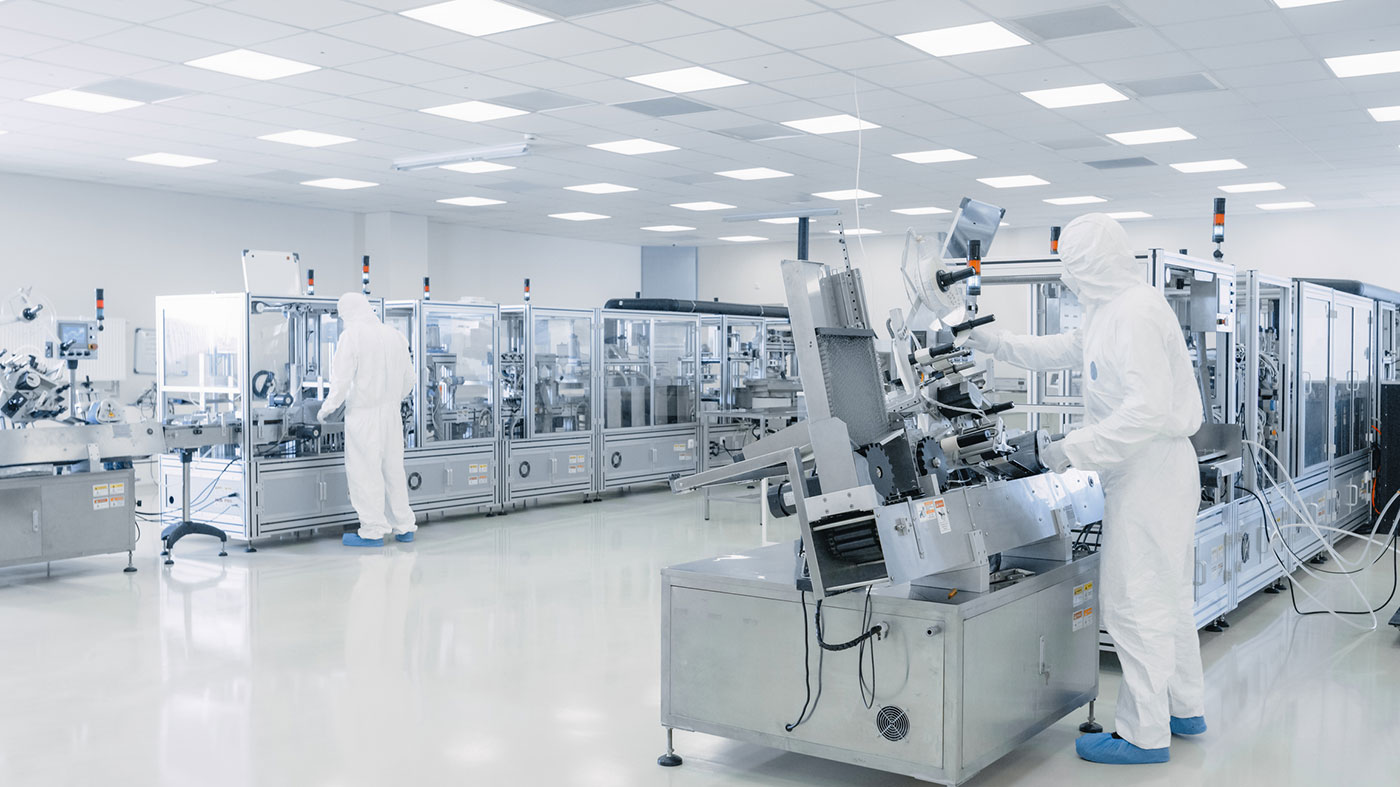
“Bright” does not automatically mean “effective.” Pharmaceutical cleanrooms require lighting that supports the actual task: reading batch records, inspecting labels, observing product, checking surfaces, operating controls, performing manual assembly, or completing maintenance work.
The lighting design should consider:
- Illumination level at the actual work plane
- Uniformity across workstations and equipment
- Shadows around process skids, work tables, filling lines, and vessels
- Glare on stainless steel, glass, polished surfaces, and touchscreen controls
- Color quality for label reading and visual inspection
- Light distribution around HEPA modules, ductwork, and ceiling obstructions
General lighting may be adequate for circulation and broad room visibility, while inspection, weighing, documentation, and detailed assembly areas may require more targeted task illumination.
A photometric layout is especially valuable in cleanrooms with complex equipment. It helps confirm that the design produces usable light where employees work, rather than merely meeting an average foot-candle number on a plan.
Select Color Quality Carefully
Color quality influences visual inspection, label verification, equipment identification, and employee comfort during long shifts. A high-quality LED fixture should provide consistent color output and adequate color rendering for the tasks performed in the room.
When evaluating LED cleanroom lighting, consider:
- Color rendering performance
- Color consistency between fixtures
- Color temperature consistency from room to room
- Lumen maintenance over time
- Expected color shift as fixtures age
- Availability of comparable replacement fixtures
Neutral-white light is common in controlled manufacturing and laboratory settings because it supports visual clarity and a clean appearance. The precise color temperature should align with facility standards, task requirements, and user preferences rather than being selected solely because it is fashionable or readily available.
Coordinate Lighting With Ceiling and Airflow Systems
The ceiling plane in a pharmaceutical cleanroom often includes lighting, HEPA filters, fan-filter units, return-air grilles, sprinklers, speakers, cameras, sensors, and utility penetrations. Each element must work together without compromising cleanability or controlled airflow.
Coordinate lighting layout with the cleanroom designer, mechanical engineer, electrical engineer, and process team early in the project. Key issues include:
- Fixture dimensions relative to ceiling-panel modules
- Flushness and sealing at ceiling penetrations
- Interference with HEPA filters or fan-filter units
- Access for electrical connections and future maintenance
- Airflow patterns around the fixture
- Locations of process equipment and operator work areas
- Coordination with emergency lights and exit signs
Cleanroom lighting should not create unsealed openings or difficult-to-clean transitions between the fixture and ceiling. Sealed fixtures are commonly used to reduce the potential for dust or particles to enter through the lighting assembly.
Plan for Maintenance Before Installation
In a cleanroom, routine lighting maintenance can be more disruptive than in a conventional facility. Replacing a driver, opening a lens, or removing a fixture may require controlled access, cleaning, downtime, and coordination with production or quality teams.
Before specifying a fixture, ask:
- How is the fixture accessed and serviced?
- Can maintenance occur from above the ceiling, below the ceiling, or both?
- Can drivers or other components be replaced?
- Does fixture service compromise the ceiling seal?
- Are replacement parts readily available?
- Is the fixture rated for the room’s actual ambient conditions?
- Are surge-protection components included?
- Can the facility standardize fixtures across multiple rooms?
Standardization reduces spare-parts inventory, improves technician familiarity, and helps maintain consistent lighting performance throughout the facility. SpecGrade’s industrial LED lighting solutions can be evaluated alongside maintenance-access, environmental, and application requirements.

Keep GMP and HazLoc Separate
A pharmaceutical cleanroom does not automatically require hazardous-location-rated lighting. GMP cleanability requirements and hazardous-location classifications are separate issues.
Hazardous-location fixtures are appropriate only when the formal area-classification assessment identifies flammable vapors, gases, combustible dust, or ignitable fibers. This may occur in solvent-handling rooms, alcohol-based cleaning areas, certain dispensing operations, or dust-generating powder processes.
Where the facility requires both cleanability and a classified-location rating, the project team should evaluate fixtures that meet the applicable electrical requirements and the actual environmental needs of the room. SpecGrade’s hazardous-location product catalog can help project teams begin evaluating options, but final selection should follow the area-classification study and applicable code requirements.
Include Emergency Lighting
Emergency lighting should support safe evacuation and an orderly process response if normal power is lost. Coordinate exit signs, battery-backed fixtures, generator-supported circuits, and emergency-light testing with the facility’s life-safety plan.
In some pharmaceutical environments, basic egress lighting may not be enough. Operators may need sufficient backup illumination to safely stabilize equipment, secure materials, or complete a controlled shutdown. Determine those needs with the facility’s engineering, EHS, operations, and quality teams.
Ask the Right Questions
Before selecting a lighting package for a pharmaceutical cleanroom, the project team should be able to answer:
- What ISO/GMP classification and process occur in the room?
- What cleaning chemicals and sanitation frequency will the fixture experience?
- What illumination and color-quality requirements apply to the task?
- How will the fixture integrate with the ceiling and airflow strategy?
- How will the fixture be maintained without disrupting the controlled environment?
- Does the area require a hazardous-location classification?
- Are emergency and backup lighting needs addressed?
- Is the fixture documentation sufficient for engineering, commissioning, qualification, and maintenance records?
Choosing cleanroom lighting is ultimately a system-design decision. The ideal fixture is not simply the brightest or lowest-cost option. It is the one that supports cleanability, contamination control, visibility, reliability, safety, and maintenance throughout the life of the pharmaceutical facility.
Need help evaluating lighting for a pharmaceutical cleanroom, aseptic processing area, packaging space, laboratory, utility room, or solvent-handling application? Contact SpecGrade’s application team to discuss fixture construction, cleaning requirements, photometric performance, maintenance access, and hazardous-location considerations.