How to Vet a Hazardous Location Retrofit Claim: A Buyer’s Due-Diligence Checklist
A certification mark on a product sheet is a claim. The entry in the certifying body’s public database is the proof. Here are ten questions that turn one into the other — and the red flags that mean you should stop reading the brochure.
The LED retrofit market for classified areas has grown quickly, and the quality of the compliance claims in it varies enormously. Some suppliers hold exactly the certification they say they hold. Others cite a standard that does not cover hazardous locations, or show a mark for a certification that has not been issued yet, or describe an environment far broader than what their marking actually permits.
None of that is hard to detect. It takes about fifteen minutes and a public database. This checklist is what we would want a specifying engineer to run on any supplier in this category, ourselves included.
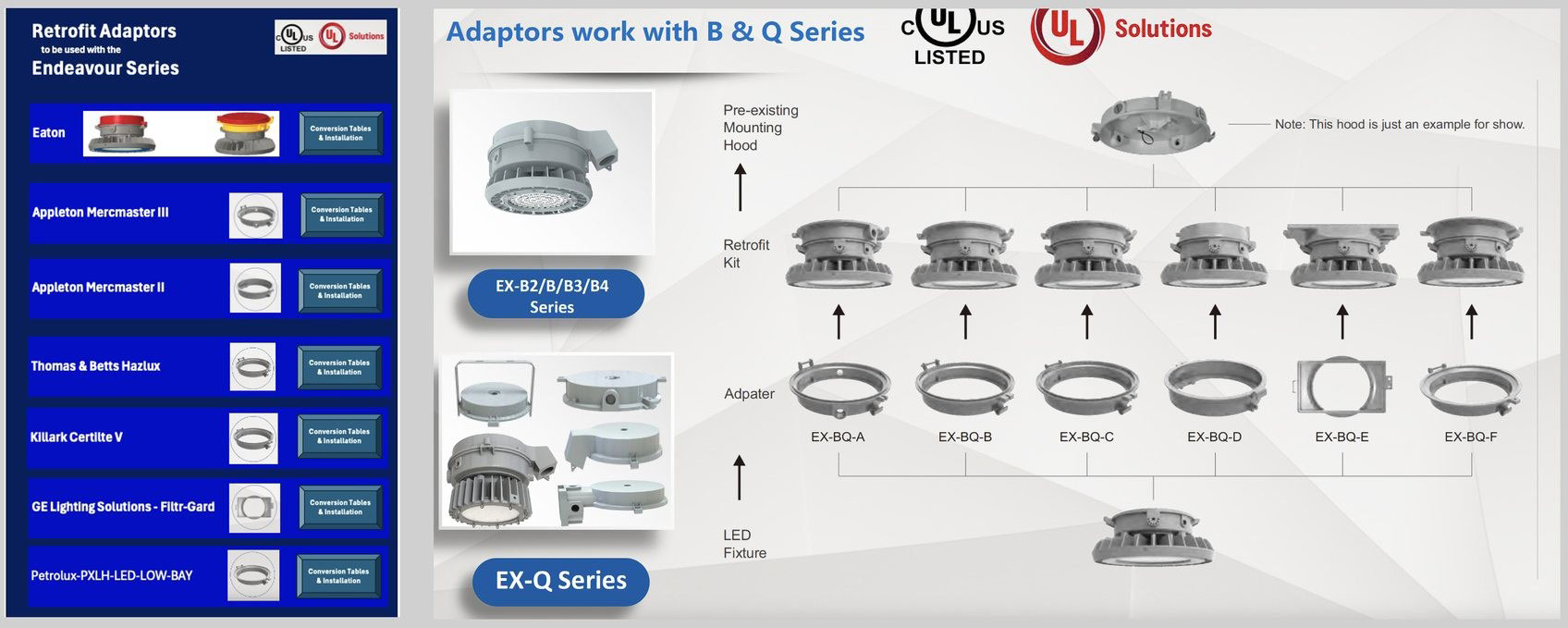
A host-by-host adaptor cross-reference. The architecture diagram at right shows the pre-existing mounting hood retained in place, with an adapter mating it to the LED fixture — the conduit seal is never broken and the hood never leaves the structure.
First: get the right standard named
Most bad claims in this market collapse at the first question, because the wrong standard is being cited.
UL 1598C is the standard for LED retrofit luminaire conversion kits. It is a legitimate and widely used standard, and on its own it addresses ordinary locations. It is not a hazardous location standard. If a supplier offers only UL 1598C for equipment going into a classified area, the conversation should stop there.
What you should be hearing instead depends on how the area is classified:
| If the area is classified as | The certification should reference |
| Class / Division (NEC Article 500) | UL 844, the standard for luminaires for use in hazardous (classified) locations, and its Canadian counterpart CSA C22.2 No. 137. For a conversion kit, UL certifies to UL 844 and UL 1598C together. |
| Zone (NEC Article 505, or IEC / ATEX practice) | The 60079 series — UL/CSA 60079 in North America, IEC 60079 internationally — with the specific parts matching the protection concept (60079-0 general, -1 flameproof, -7 increased safety, -11 intrinsic safety, and so on). |
UL also maintains a distinct product category for this exact product type. IFUL covers LED retrofit luminaire conversion kits for use in hazardous locations, certified to both UL 1598C and UL 844. That is different from IFAR, the ordinary-location category. Knowing the category code lets you search the database directly rather than taking a supplier’s word for the scope.
The ten questions
Ask for written answers. A supplier who is properly certified can answer all ten in a single email.
-
- Which certification body, and is it OSHA-recognized for this standard? UL, Intertek/ETL, CSA, and FM are all legitimate. What matters is whether the body is recognized for the specific standard in question. OSHA publishes both the NRTL program roster and the list of standards each body is recognized for. A certification issued outside a body’s scope of recognition is not acceptable to OSHA.
- Which standards, by number and edition? See the table above. “UL certified” with no standard named is not an answer; it is a brand reference.
- What is the file number and product category code? This is the single most useful thing you can ask for, because it lets you leave the supplier’s website. Look it up yourself in UL Product iQ, the ETL Listed Mark Directory, or the equivalent database for whichever body issued it.
- Is it a Listing, a Classification, or a Recognized Component? These are not interchangeable. A Recognized Component is evaluated for use inside a larger product and is not an end product. Retrofit kits typically carry a Classification or Enhanced Mark. A component certification presented as product certification is a meaningful misrepresentation, not a labeling nuance.
- Which host luminaires, specifically? Kits may be certified either for named host models or for generic host types meeting explicit mechanical and electrical criteria stated in the installation instructions. Both are legitimate. “Works with most standard fixtures” is neither. Where specific models are covered, the manufacturer and model numbers appear in the instructions and on the package.
- What Class, Division or Zone, and which groups? Groups matter more than people expect. Group D (typical hydrocarbon service) is a materially easier qualification than Group C, B, or A. A product rated Class I Division 2 Groups C and D does not cover a hydrogen or acetylene area, and a Division 2 rating does not cover a Division 1 location.
- What is the temperature code and ambient range — for the converted luminaire? Not for a driver or module inside it. Internal enclosure temperatures run well above outdoor ambient, so a component rating tells you very little. Check that the stated ambient range covers your site’s actual extremes at both ends; low-temperature limits are frequently the binding constraint in northern service.
- Can I see the installation instructions before I buy? The instructions are part of the certification, and installing contrary to them is a code violation in its own right under NEC 110.3(B). If a supplier will not release them pre-purchase, you cannot evaluate whether your crews can actually comply.
- What field-applied label goes onto the fixture after conversion? Certified kits include labels to affix to the host luminaire after installation. That label is what an inspector looks for and what the facility’s asset record should reflect. If there is no label, ask what the converted fixture is supposed to be marked with.
- Does the resulting marking match our area classification drawing? This is the one nobody asks. Pull the area classification drawing for the specific area, and confirm Class, Division or Zone, group, and temperature code line up. Certification tells you what the product is; only the drawing tells you what the location needs.
Verify it yourself — it takes minutes
A mark on a sheet is a claim; the database entry is the proof. Every major body publishes a free, public directory: UL Product iQ, Intertek’s product directories, and CSA Group. For Zone-rated or internationally certified equipment, the IECEx On-Line Certificate System lists every certificate issued under the scheme. IECEx is explicit on the point: if it is not listed on the OCS, it is not IECEx certified.
Match four things: the manufacturer name, the model number, the standards cited, and the ratings. A near miss on any of them is worth a question. A model number that does not appear at all is the end of the evaluation.
Seven red flags
Any one of these should stop a specification until it is resolved in writing.
- A certification mark displayed alongside language like “certificate pending” or “certification in progress.” Applying a mark to a product that does not hold the certification is mark misuse. UL operates a market surveillance reporting channel for it.
- “Explosionproof” used to describe a Division 2 product. Explosionproof is a Division 1 protection concept — an enclosure built to contain an internal ignition. Division 2 equipment normally relies on nonincendive, hermetically sealed, or sealed-device protection. Mixing the terms suggests either confusion or an attempt to imply a higher rating.
- A description broader than the marking. Marketing copy mentioning gases, vapors, fibers, and dust against a marking that reads Class I only. Fibers are Class III and dust is Class II; a Class I certification covers neither.
- No ratings block anywhere in the literature. Class, Division or Zone, groups, temperature code, and ambient range are the minimum. Their absence is not an oversight in a document that is otherwise detailed.
- Only UL 1598C cited for a classified-location product.
- A component’s rating quoted as the product’s rating. A driver rated to 60°C ambient inside an enclosure is not a fixture rated to 60°C ambient — and internal enclosure temperature is what actually kills the driver.
- Reluctance to provide the file number. The file number is not proprietary. It is published. Hesitation here is informative.
Apply this to us
 This checklist is deliberately written to be used against every supplier in the category, including this one. That is the only version worth publishing. A checklist calibrated so that exactly one product passes is a sales document wearing a lab coat, and experienced specifiers recognize it immediately.
If you run these ten questions on our literature and something comes back thin — a ratings block that should be more complete, a host list that needs more detail — tell us. The right response to a failed item is a corrected document, not an argument. We would rather fix a data sheet than win a specification we could not defend at the inspection.
And if you want the code background behind why the host-luminaire question matters so much, start with does an LED retrofit void a hazardous location luminaire’s listing? The 2026 National Electrical Code added Section 501.130(C), which permits retrofit kits that are listed for the location and listed for field installation with the luminaire being retrofitted. Adoption runs state by state, so check the NFPA enforcement maps for the edition in force where you are working. UL’s retrofit kit FAQ covers the certification mechanics in more detail.
[Placeholder for product close: publish your own answers to all ten questions — certification body, standards, file number and category code, mark type, host luminaire list, Class/Division and groups, T-code and ambient range, installation instructions link, and field label. Offer the checklist as a one-page download.]
Standards and references: OSHA NRTL program · NRTL scopes of recognition · OSHA 1910.307 · UL Product iQ · UL 844 · IFUL category · Intertek product directories · ETL Listed Mark Directory · CSA Group · IECEx On-Line Certificate System · IECEx · IEC 60079-0 · NEC free access · NEC enforcement maps · UL market surveillance reporting
This article is general information about published codes and standards, not a compliance determination for any specific installation. Code editions, local amendments, and product certifications vary. Confirm requirements with the authority having jurisdiction and verify any certification claim directly in the certifying body’s database.
About The Author
Rick Nathans and Doug Lauck are the CEO and COO of SpecGrade. Both have worked in LED lighting since 2010 and have contributed to the design of numerous LED luminaires. They stay close to the details — temperature codes and area classifications, driver selection, optics, mounting hardware, and serviceability — which lets them support customers through design reviews, standards compliance discussions, and value engineering exercises with safety and uptime front and center.
About SpecGrade
Based in Columbus, Ohio, SpecGrade designs and distributes commercial and industrial LED luminaires for mission-critical environments where safety, uptime, and compliance are non-negotiable. Its position in the supply chain allows for certain fixture modifications while maintaining UL 844 compliance, along with updated BIM/Revit files for the project. Many of SpecGrade’s industrial fixtures are purpose-built for hazardous and classified locations containing flammable gases, vapors, combustible dusts, or ignitable fibers, protecting people, facilities, and assets while delivering dependable, high-quality illumination.